Get Instant Access of 100% Real Microsoft DP-300 Exam Questions with Verified Answers [Q238-Q255]

Rate this post

Get Instant Access of 100% Real Microsoft DP-300 Exam Questions with Verified Answers

Exam Dumps for the Preparation of Latest DP-300 Exam Questions

Microsoft DP-300 Exam Syllabus Topics:

Section Weight Objectives
Topic 1: Implement a secure environment 20–25% – Secure data at rest and in transit

  • 1. Manage keys and certificates
    • 2. Configure encryption for connections and data transfer
      • 3. Implement Transparent Data Encryption

        – Configure authentication and authorization

        • 1. Apply least privilege principle
          • 2. Implement Microsoft Entra ID authentication
            • 3. Manage database users, roles, and permissions

              – Implement compliance and security controls

              • 1. Assess and remediate vulnerabilities
                • 2. Configure auditing and logging
                  • 3. Implement data masking and classification
                    Topic 2: Monitor and optimize operational resources 15–20% – Optimize resource consumption

                    • 1. Manage costs and licensing
                      • 2. Adjust compute, storage, and tier settings
                        • 3. Implement auto-scaling and elasticity

                          – Automate maintenance and operations

                          • 1. Manage database lifecycle operations
                            • 2. Automate tasks using jobs, scripts, or Logic Apps
                              • 3. Schedule and perform updates and patches

                                – Monitor database performance and health

                                • 1. Use Azure Monitor, SQL Insights, and metrics
                                  • 2. Set up alerts and notifications
                                    • 3. Identify and diagnose performance issues
                                      Topic 3: Plan and implement data platform resources 15–20% – Deploy database resources

                                      • 1. Automate deployment using templates, PowerShell, or CLI
                                        • 2. Configure resources for scale and performance
                                          • 3. Deploy Azure SQL Database, Managed Instance, and SQL Server on Azure VMs

                                            – Plan deployment of database offerings

                                            • 1. Identify use cases for hybrid and multi-cloud solutions
                                              • 2. Plan for scalability and performance requirements
                                                • 3. Evaluate deployment options for Azure SQL services

                                                  – Implement migration strategies

                                                  • 1. Migrate between Azure services or from on-premises
                                                    • 2. Evaluate migration requirements and strategies
                                                      • 3. Perform offline and online migrations
                                                        Topic 4: Optimize query performance 15–20% – Manage workload performance

                                                        • 1. Troubleshoot slow-running queries
                                                          • 2. Control resource usage and concurrency
                                                            • 3. Implement partitioning and compression

                                                              – Improve query performance

                                                              • 1. Create and modify indexes
                                                                • 2. Optimize T-SQL code and constructs
                                                                  • 3. Use query store and performance tuning tools

                                                                    – Analyze query execution plans

                                                                    • 1. Evaluate index usage and design
                                                                      • 2. Interpret execution plans and statistics
                                                                        • 3. Identify bottlenecks and inefficiencies
                                                                          Topic 5: Plan and configure high availability and disaster recovery 20–25% – Design HA/DR strategy

                                                                          • 1. Define RPO and RTO requirements
                                                                            • 2. Choose between built-in and custom solutions
                                                                              • 3. Evaluate hybrid and cross-region options

                                                                                – Configure high availability solutions

                                                                                • 1. Implement failover groups and auto-failover
                                                                                  • 2. Test and monitor HA/DR operations
                                                                                    • 3. Configure Always On availability groups

                                                                                      – Implement backup and restore

                                                                                      • 1. Perform point-in-time and long-term retention restores
                                                                                        • 2. Manage backup storage and costs
                                                                                          • 3. Configure automated backups and retention


                                                                                            NO.238 You have a Microsoft SQL Server database named DB1 that contains a table named Table1.
                                                                                            The database role membership for a user named User1 is shown in the following exhibit.

                                                                                            Use the drop-down menus to select the answer choice that completes each statement based on the information presented in the graphic.
                                                                                            NOTE: Each correct selection is worth one point.

                                                                                            NO.239 You have an Azure subscription. The subscription contains three instances of SQL Server on Azure Virtual Machines that run Windows Server. The subscription contains an Azure load balancer named LB1.
                                                                                            You implement an Always On availability group named AO1. You deploy a listener named AG1 and link AO1 to LB1.
                                                                                            You need to configure a load balancing rule for LB1. The solution must ensure that traffic can flow to AG1.
                                                                                            What should you use as the backend port?


                                                                                            NO.240 You are designing an enterprise data warehouse in Azure Synapse Analytics that will store website traffic analytics in a star schema.
                                                                                            You plan to have a fact table for website visits. The table will be approximately 5 GB.
                                                                                            You need to recommend which distribution type and index type to use for the table. The solution must provide the fastest query performance.
                                                                                            What should you recommend? To answer, select the appropriate options in the answer area.
                                                                                            NOTE: Each correct selection is worth one point.

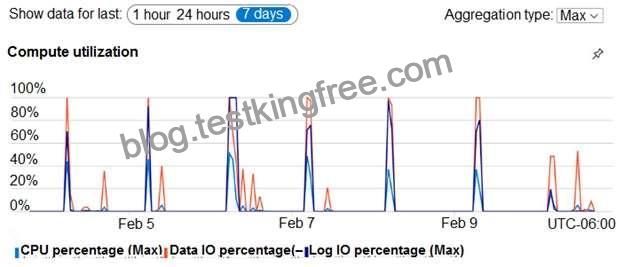
                                                                                            NO.241 You need to implement the monitoring of SalesSQLDb1. The solution must meet the technical requirements.
                                                                                            How should you collect and stream metrics? To answer, select the appropriate options in the answer area.
                                                                                            NOTE:Each correct selection is worth one point.

                                                                                            NO.242 You have an Azure virtual machine named VM1 on a virtual network named VNet1. Outbound traffic from VM1 to the internet is blocked.
                                                                                            You have an Azure SQL database named SqlDb1 on a logical server named SqlSrv1.
                                                                                            You need to implement connectivity between VM1 and SqlDb1 to meet the following requirements:
                                                                                            Ensure that VM1 cannot connect to any Azure SQL Server other than SqlSrv1.
                                                                                            Restrict network connectivity to SqlSrv1.
                                                                                            What should you create on VNet1?


                                                                                            NO.243 You have an Azure subscription that contains an instance of SQL Server on Azure Virtual Machines named SQLVM1 and a user named User1. SQLVM1 hosts a database named DB1.
                                                                                            You need to ensure that User1 can perform the following tasks on DB1:
                                                                                            * Create jobs.
                                                                                            * View all jobs.
                                                                                            * Modify, delete, and disable the jobs the user created.
                                                                                            The solution must use the principle of least privilege.
                                                                                            Which built-in database role should you assign to User1, and where is the role defined? To answer, select the appropriate options in the answer area.
                                                                                            NOTE: Each correct selection is worth one point.

                                                                                            NO.244 Note: This question is part of a series of questions that present the same scenario. Each question in the series contains a unique solution that might meet the stated goals. Some question sets might have more than one correct solution, while others might not have a correct solution.
                                                                                            After you answer a question in this section, you will NOT be able to return to it. As a result, these questions will not appear in the review screen.
                                                                                            You have an Azure Synapse Analytics dedicated SQL pool that contains a table named Table1.
                                                                                            You have files that are ingested and loaded into an Azure Data Lake Storage Gen2 container named container1.
                                                                                            You plan to insert data from the files into Table1 and transform the data. Each row of data in the files will produce one row in the serving layer of Table1.
                                                                                            You need to ensure that when the source data files are loaded to container1, the DateTime is stored as an additional column in Table1.
                                                                                            Solution: You use a dedicated SQL pool to create an external table that has an additional DateTime column.
                                                                                            Does this meet the goal?


                                                                                            NO.245 You have an Azure SQL database named sqldb1.
                                                                                            You need to minimize the possibility of Query Store transitioning to a read-only state.
                                                                                            What should you do?


                                                                                            NO.246 You have an Azure SQL database named DB1. The automatic tuning options for DB1 are configured as shown in the following exhibit.

                                                                                            For each of the following statements, select Yes if the statement is true. Otherwise, select No.
                                                                                            NOTE: Each correct selection is worth one point.

                                                                                            NO.247 You have an Azure Stream Analytics job.
                                                                                            You need to ensure that the job has enough streaming units provisioned.
                                                                                            You configure monitoring of the SU % Utilization metric.
                                                                                            Which two additional metrics should you moni tor? Each correct answer presents part of the solution.
                                                                                            NOTE: Each correct selection is worth one point.


                                                                                            NO.248 You are performing exploratory analysis of bus fare data in an Azure Data Lake Storage Gen2 account by using an Azure Synapse Analytics serverless SQL pool.
                                                                                            You execute the Transact-SQL query shown in the following exhibit.

                                                                                            Use the drop-down menus to select the answer choice that completes each statement based on the information presented in the graphic.

                                                                                            NO.249 You need to implement statistics maintenance for SalesSQLDb1. The solution must meet the technical requirements.
                                                                                            Which four actions should you perform in sequence? To answer, move the appropriate actions from the list of actions to the answer area and arrange them in the correct order.

                                                                                            NO.250 You have an Azure SQL database that contains a table named factSales. FactSales contains the columns shown in the following table.

                                                                                            FactSales has 6 billion rows and is loaded nightly by using a batch process.
                                                                                            Which type of compression provides the greatest space reduction for the database?


                                                                                            NO.251 Note: This question is part of a series of questions that present the same scenario. Each question in the series contains a unique solution that might meet the stated goals. Some question sets might have more than one correct solution, while others might not have a correct solution.
                                                                                            After you answer a question in this section, you will NOT be able to return to it. As a result, these questions will not appear in the review screen.
                                                                                            You have an Azure Synapse Analytics dedicated SQL pool that contains a table named Table1.
                                                                                            You have files that are ingested and loaded into an Azure Data Lake Storage Gen2 container named container1.
                                                                                            You plan to insert data from the files into Table1 and transform the data. Each row of data in the files will produce one row in the serving layer of Table1.
                                                                                            You need to ensure that when the source data files are loaded to container1, the DateTime is stored as an additional column in Table1.
                                                                                            Solution: You use a dedicated SQL pool to create an external table that has an additional DateTime column.
                                                                                            Does this meet the goal?


                                                                                            NO.252 You have an Azure SQL database named DB1.
                                                                                            You need to display the estimated execution plan of a query by using the query editor in the Azure portal.
                                                                                            What should you do first?


                                                                                            NO.253 You need to provide an implementation plan to configure data retention for ResearchDB1. The solution must meet the security and compliance requirements.
                                                                                            What should you include in the plan?


                                                                                            NO.254 You are performing exploratory analysis of bus fare data in an Azure Data Lake Storage Gen2 account by using an Azure Synapse Analytics serverless SQL pool.
                                                                                            You execute the Transact-SQL query shown in the following exhibit.

                                                                                            Use the drop-down menus to select the answer choice that completes each statement based on the information presented in the graphic.

                                                                                            NO.255 You have an Azure SQL database.
                                                                                            You have a query and the associated execution plan as shown in the following exhibit.

                                                                                            Use the drop-down menus to select the answer choice that completes each statement based on the information presented in the graphic.
                                                                                            NOTE: Each correct selection is worth one point.


                                                                                            Download Latest & Valid Questions For Microsoft DP-300 exam: https://www.testkingfree.com/Microsoft/DP-300-practice-exam-dumps.html


                                                                                            Related Links: myportal.utt.edu.tt myportal.utt.edu.tt telegra.ph myportal.utt.edu.tt myportal.utt.edu.tt myportal.utt.edu.tt

                                                                                            Related Posts

                                                                                            Leave a Reply

                                                                                            Your email address will not be published. Required fields are marked *

                                                                                            Enter the text from the image below